
Voice AI Features
We provide a wide range of integrations
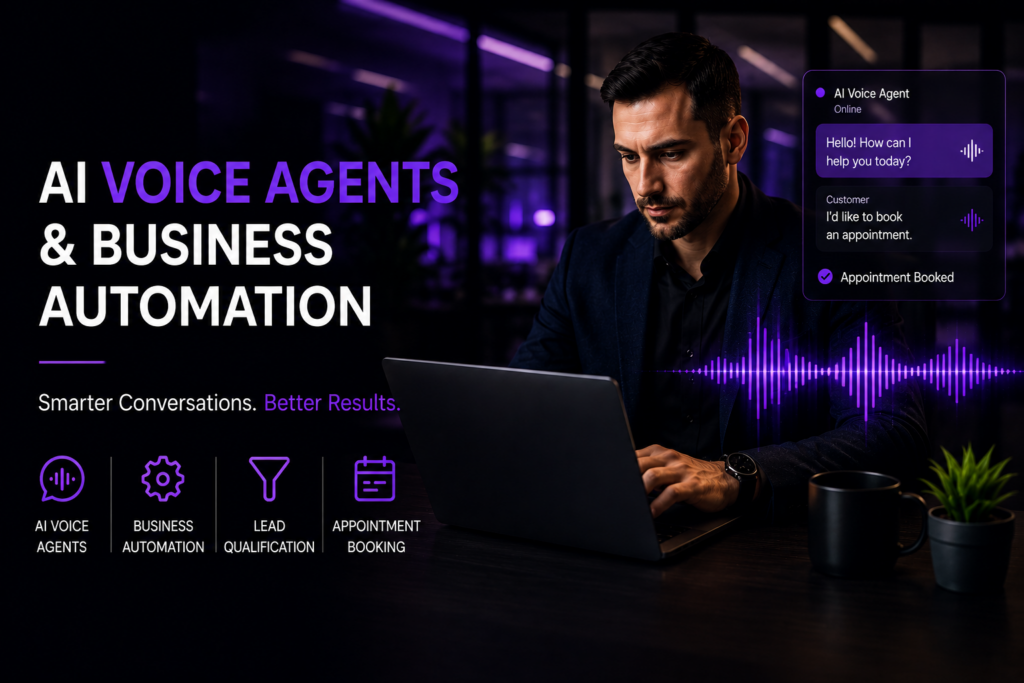
Voice AI agents can be used as a stand alone application, or it can be used to integrate into multiple third party applications to streamline your business processes.
AI Voice Agents in Business: Transforming How Companies Communicate
AI voice agents — sometimes called conversational voice assistants or intelligent virtual receptionists — are rapidly reshaping the way businesses handle customer calls, internal workflows, and front-line engagement. Unlike traditional automated phone menus, modern AI voice agents use natural language processing (NLP), machine learning, and conversational design to interpret spoken language, understand context, and respond in a way that feels intuitive and human-like.
At their core, voice AI agents work by converting speech into text, processing it through AI models trained to understand intent, then generating context-appropriate responses. These responses can be spoken back to the caller, escalated to a human agent, or used to trigger actions — such as scheduling appointments, recording customer information, or providing real-time updates.
Why Now Is the Right Time to Adopt Voice AI
Several factors make this a pivotal moment for businesses to embrace voice AI:
Access to advanced NLP – Recent breakthroughs in large language models have yielded conversational accuracy once thought years away.
Demand for instant service – Customers expect quick answers — especially outside business hours — and voice AI delivers without fatigue or wait times.
Competitive pressure – Early adopters are using voice AI to lower costs and improve operational efficiency, forcing others to catch up or risk lagging.
Advantages of Implementing Voice AI
The benefits of voice AI adoption are substantial:
24/7 Availability: AI agents never sleep — providing support even when your human team is offline.
Reduced Operational Costs: Repetitive customer interactions get automated, freeing staff for higher-value work.
Improved Customer Experience: Faster responses and reduced hold times lead to higher satisfaction.
Scalable Support: Voice AI scales seamlessly during high demand, peak seasons, or rapid growth.
Consistent Messaging: AI delivers uniform responses, reducing training and quality control challenges.
Disadvantages of Not Having Voice AI
Businesses that delay adopting voice AI risk several strategic downsides:
Missed leads and revenue: Slow response times often lead customers to look elsewhere.
Higher labor costs: Handling all calls manually can be expensive and limits scalability.
Inconsistent performance: Human variability in tone, knowledge, and accuracy can hinder trust and experience.
Operational bottlenecks: Without automation, repetitive tasks drain valuable human hours.
Best Sectors for Voice AI
While voice AI has broad applicability, certain industries benefit most:
Healthcare: Appointment scheduling, reminders, and patient FAQs.
Service Industries: Salons, auto repair shops, and professional services use voice AI for bookings and follow-ups.
Real Estate: Lead qualification and property information dissemination.
Hospitality & Travel: Reservation management and traveler support.
Retail & eCommerce: Order status inquiries, returns protocols, and product guidance.
Financial Services: Balance inquiries, basic account actions (with proper security).
Integration with Other Systems
One of the most powerful aspects of voice AI today is integration capability. Voice agents can connect with:
Calendars & Scheduling Systems: Automatically book, modify, or cancel appointments (e.g., Google Calendar, Outlook, Calendly).
CRMs: Log leads and interaction history in platforms like HubSpot or Salesforce.
Helpdesk Software: Create support tickets and escalate complex issues.
Order Management Systems: Provide real-time tracking and status updates.
These integrations make voice AI far more than a calling bot — it becomes an intelligent business assistant embedded into the tech stack.
What the Future Holds
The trajectory of voice AI suggests increasing sophistication and deeper business integration. We’re likely to see:
Emotion detection: Voice agents interpreting sentiment to tailor responses.
Predictive engagement: Initiating support calls based on customer behaviour patterns.
Full omnichannel continuity: Switching seamlessly between voice, chat, and text without losing context.
Voice AI teams: Multiple AI agents collaborating to handle complex workflows.
In an era where customer expectations are rising and competition is fierce, voice AI offers businesses a strategic resource — driving efficiency, boosting satisfaction, and enabling scalability. The companies that adopt early will not only streamline operations but also redefine what exceptional service looks like in the digital age.
Key Voice AI Integrations
To get the best out of our voice agents, you can integrate them with key third party applications
Calendar
Call Transfer
SMS
Google Sheets
CRM
Chat with KORA our AI Assistant 👉
Ask questions, explore how the system works, and book a discovery call directly through our AI assistant.